How to Create an AI Use-Case Risk Assessment Before Deployment
Responsible AI Adoption and Digital Trust
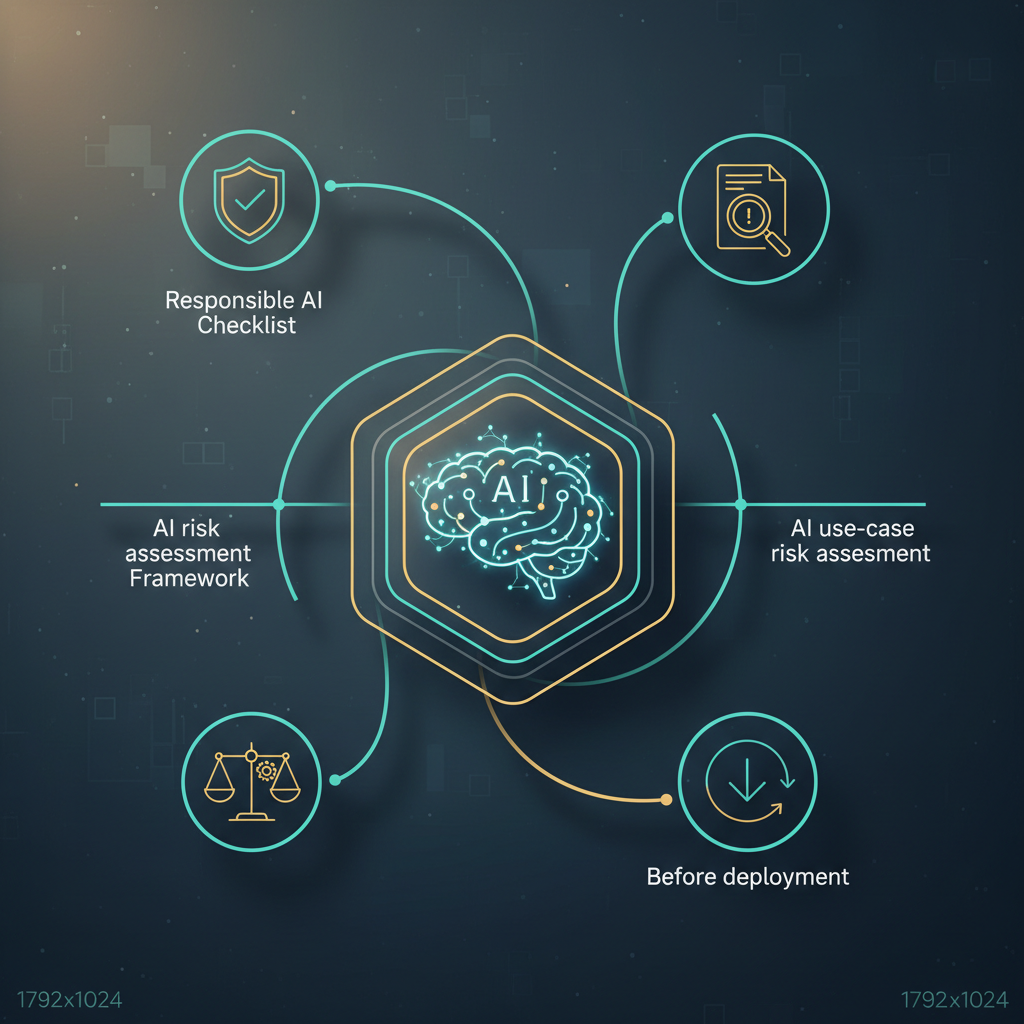
What if an AI pilot seems safe because it only writes replies? It can still decide which customers get help first. This is how teams mistake a small feature for a low-risk rollout.
An AI use case risk assessment should look at how the model operates, not just what it delivers.
A support assistant can expose personal data, repeat outdated policies, miss key escalations, or create a bad experience, even if it uses correct language.
The assessment is helpful when it results in a clear decision: approve, run a controlled pilot, revise the use case, or reject the deployment.
This decision should rely on evidence that teams can check. This includes the data used, affected people, possible failures, human oversight, and impacts on operations.
A solid AI risk assessment framework also helps avoid a common mistake: reviewing a new system while ignoring AI already in use.
In 2026, Airia found that thorough assessments often uncover two to four times more AI than organizations expect. This means discovery is part of risk control, not just cleanup.
A practical responsible AI checklist turns general principles into tasks that help support a justifiable deployment decision.
The goal is not to eliminate all uncertainty before testing. It is to clarify uncertainty, assign ownership, and ensure safe progress.
Quick Answer: When you conduct an AI use-case risk assessment, you should end up with one of four decisions: approve, pilot with controls, revise, or reject. By utilizing frameworks like the NIST AI Risk Management Framework, organizations can uncover approximately 2 to 4 times more AI systems than expected, which enhances risk management and governance. Ensuring that assessments evaluate both the model's performance and the context of its deployment is critical for safe and responsible AI integration.
Define the Outcome, Scope, and Inputs
Begin by defining the outcome that approval must achieve. It should lead to one of four actions: approve, pilot, revise, or reject. This helps keep all teams aligned before discussing scores.
Start with a clear assessment outcome
Write a sentence that describes the use case, its users, and the decision it supports. For example: “The assistant drafts customer-support replies using approved knowledge-base content, and an agent checks each reply before sending.” Then identify whether the system is internal, customer-facing, or high-impact. A customer-facing routing assistant can impact response speed and escalation. A system that affects eligibility or access to services needs a detailed review.The NIST AI Risk Management Framework can guide you, but remember, a score alone doesn't guarantee a system is safe or lawful.
Use this simple scale for scoring:
- 1 — Low: Internal draft with no automatic action and easy human correction.
- 2 — Moderate: Customer-facing answer or routing suggestion with review before action.
- 3 — High: Sensitive data, frequent customer impact, or limited reviewer capacity.
- 4 — Critical: Severe harm is possible, or the system acts without meaningful human control.
Treat approval thresholds as adaptable, not universal, and set them based on your organization’s risk appetite and deployment context.
Gather the required inputs
Gather evidence before scoring starts. Assign one responsible owner for each item.Intake checklist
| Input | Questions to answer | Owner | Evidence to collect |
|---|---|---|---|
| Use-case description | What will the AI do? | Product | Product requirements |
| Users and affected people | Who uses or receives the output? | Operations | User and impact map |
| Data sources and sensitivity | What data enters the system? | Security | Data inventory |
| AI output and action | What happens after generation? | Product | Workflow specification |
| Human review process | Who reviews, and when? | Operations | Review procedure |
| Failure scenarios | How could an error cause harm? | Compliance | Risk log |
| Deployment environment | Where will it run and connect? | Engineering | Security review |
| Monitoring and escalation plan | How are errors detected and routed? | Support | Monitoring plan |
Score the AI Use Case Step by Step
For each risk assessment, use these five dimensions. Score each from 1 to 4, document evidence, and assign one owner from product, security, legal, compliance, operations, or support.
- Score impact. Assign
1for a low-impact internal draft,2for a customer support suggestion,3for an automatic customer reply, and4for a decision affecting access, safety, money, or rights. Document who is affected, the business outcome, and why you gave that score. - Score data sensitivity. Assign
1for public knowledge-base content,2for basic account details,3for sensitive customer records, or4for regulated or highly confidential data. Think about inputs and outputs. List every data category, storage location, access group, and privacy constraint. - Score human oversight. Assign
1when a person reviews every output,2when a person approves delivery,3when people review samples or exceptions, or4when the system acts without meaningful review. Identify the owner who can explain when to intervene, review steps, and how to stop the workflow. - Score failure severity. Assign
1to an easily corrected wording error,2to a misleading support answer,3to a missed escalation, or4to an irreversible or harmful action. Document the likely failure, detection method, rollback path, and maximum plausible harm. The NIST AI Risk Management Framework offers useful governance, but a score alone does not guarantee safety. - Calculate the total risk score. Add the five dimension scores using the following risk scoring table:
| Risk dimension | Low score: 1 | Medium score: 2 | High score: 3 | Critical score: 4 |
|---|---|---|---|---|
| Impact | Internal draft | Support suggestion | Automated customer reply | Decision affecting rights, money, or safety |
| Data sensitivity | Public content | Basic account data | Sensitive customer records | Regulated or highly confidential data |
| Human oversight | Reviews every output | Approves before delivery | Samples or exceptions | No meaningful review |
| Failure severity | Easy wording fix | Misleading answer | Missed escalation | Irreversible or harmful action |
| Total score interpretation | 5–8: approve only with controls | 9–12: pilot with monitoring | 13–16: revise controls before pilot | 17–20: reject or redesign |
Convert the Score Into a Deployment Decision
Use the completed assessment to decide on an action, not just to record a number. Treat these bands as an internal operating model, not regulatory advice; adapt them to your sector, customers, and risk tolerance.
1. Set the approval band
Identify the greatest concern across the five dimensions, not just the average score. A customer-support system that drafts replies may have a low score, but still requires escalation if the failure severity is high.| Risk level | Typical profile | Required controls | Approval path | Deployment recommendation |
|---|---|---|---|---|
| Low | Internal assistance; limited data; reversible errors | Basic access control, prompt testing, owner, activity logs | Product owner approval | Approve with routine monitoring |
| Moderate | Customer-facing drafts or routing; moderate business impact | Knowledge review, human approval, quality sampling, escalation path | Product plus operations approval | Pilot with usage limits |
| High | Sensitive data, broad customer impact, or serious error consequences | Privacy and security review, documented testing, human oversight, incident plan | Cross-functional approval from product, security, legal, and compliance | Pilot only after controls pass |
| Critical or unresolved | Material harm possible, unclear ownership, failed tests, or missing evidence | Redesign, stronger safeguards, independent review, or formal risk acceptance | Executive or designated risk authority | Revise or reject until resolved |
Test the Assessment Against Realistic Failure Modes
A completed risk assessment is useful only if it works against real customer-support failures.
Test the workflow using tough inputs, missing evidence, unclear ownership, and answers that sound good but are wrong.
Run the assessment under pressure
- Clarify the use case. Avoid vague descriptions like “AI handles support.” Write the exact channel, user, decision, knowledge source, and allowed action. For example, “drafts email replies from approved help-center content; an agent approves every send.” Success means another reviewer can describe the workflow without asking what the system actually does.
- Trace sensitive data. Send test records that include account details, private messages, and authentication information. Check whether this data enters prompts, application logs, training stores, or connected knowledge bases. A responsible checklist should identify each location, how long records are kept, who has access, and the deletion process. If any path is unclear, mark the data-sensitivity score as
4until evidence clarifies it.
- Force human-review decisions. Create cases that require escalation, such as suspected fraud, account ownership disputes, or safety concerns. Record who reviews the output, how quickly they must act, and what happens when nobody responds. Score oversight from
1when review is active and measurable to4when the system can act without meaningful control.
- Test confident errors. Feed the system outdated policy text, conflicting articles, and questions outside its approved scope. Inspect whether it refuses, cites the right source, or invents a customer answer. A polished but incorrect refund response is a failure, even when its language appears helpful. Define a stop condition, such as automatic routing to a trained agent after low confidence or conflicting evidence.
- Replace opinions with proof. For every score, attach a test result, access record, policy, owner, or monitoring measure. NIST’s AI Risk Management Framework supports this evidence-based approach rather than relying on confidence alone. If reviewers disagree, rerun the test and record the reason for the final score.
Pause approval when a failure affects sensitive data, customer rights, financial outcomes, or escalation ownership.
Choose revise or request deeper security, legal, compliance, or operational review when the team cannot reproduce the result or assign an accountable owner.
The assessment is ready for deployment review when each major failure has a documented control, an owner, and a measurable response.
Testing turns a risk score into a decision the team can defend.
Verify Readiness Before Deployment
Your assessment is ready for a deployment decision only when evidence, controls, ownership, and response plans are fully in place.
Use the final check below to confirm that the proposed workflow can operate safely in its intended setting.
Complete the assessment
- Check the evidence pack. Check that each 1-to-4 score has supporting evidence, a named owner, and a documented control. Include test results, data sources, user permissions, escalation rules, and known limitations.
Success looks like: Another reviewer can reproduce the decision without relying on informal conversations.
- Verify operational controls. Confirm that monitoring tracks answer quality, routing errors, unresolved requests, access issues, and customer complaints. Specify who reviews feedback, how often to review it, and which signal triggers a pause.
Success looks like: A support leader can identify a failing workflow and stop or limit it before harm spreads.
- Test incident response. Write the first five actions for a serious failure: contain the system, preserve relevant records, notify the accountable owner, correct affected work, and assess whether customers or regulators require notice. The NIST AI Risk Management Framework supports treating risk management as an ongoing process rather than a one-time approval.
Success looks like: Each action has an owner, a time target, and a clear escalation route.
- Choose one decision. Approve the use case only when evidence is complete and residual risk fits your organization’s tolerance. Select pilot when exposure can be kept low, revise when controls or evidence are lacking, and reject when the risk cannot be controlled.
Thresholds are internal and adaptable, not universal legal rules.
A customer-facing workflow that drafts billing replies may start as a supervised pilot, while automatic account changes may require stronger controls or rejection.
- Set the reassessment trigger. Reopen the assessment when the model, training data, users, customer population, support channel, or workflow changes. Record the next review date and the events that require an earlier review; continuous governance is also emphasized in Airia’s enterprise AI risk assessment framework.
For customer-support AI, apply the check across chat, email, and knowledge-base workflows.
Confirm that unresolved questions route to people, feedback improves approved content, and incident records remain available for review.
A completed responsible checklist should ideally end with a defensible action, not just a score.
Deployment is ready when the decision, safeguards, monitoring, and reassessment path are visible to every accountable team.
What are the key steps in conducting an AI risk assessment?
The key steps in conducting an AI risk assessment include defining the outcome and scope, scoring the AI use case across five dimensions, and converting the scores into a deployment decision. Each step requires documenting evidence and assigning ownership from relevant teams to ensure comprehensive evaluation of potential risks.
How can organizations prepare for AI compliance requirements?
Organizations can prepare for AI compliance requirements by establishing a thorough AI risk assessment framework that aligns with regulatory guidelines. Key actions include identifying potential risks, ensuring data sensitivity is properly categorized, and implementing operational controls that track AI performance and maintain compliance with regulations.
What should be included in a responsible AI checklist?
A responsible AI checklist should include criteria such as verifying data sensitivity, ensuring clear ownership, documenting evidence for risk scores, and setting operational controls. It also should encompass validation tests for realistic workflows and escalation procedures to handle potential failures or inaccuracies.
How does AI readiness affect risk assessment outcomes?
AI readiness significantly affects risk assessment outcomes by determining the completeness of evidence, controls, and plans for response. A well-prepared AI system can lead to more favorable deployment decisions, as thorough readiness evaluations help identify and mitigate risks prior to implementation.
Turn the Assessment Into a Deployment Gate
A solid AI use case risk assessment does more than give you a number.
It makes your team connect the intended outcome, scope, inputs, ownership, and impact of failures before excitement turns a pilot into production.
The strongest AI risk assessment framework is practical: it ends with a defensible decision to approve, pilot, revise, or reject—not a score that sits in a spreadsheet.
The response-drafting example shows why this is important.
A feature that appears low risk can still influence which customers receive attention first, expose sensitive information, or amplify errors from a weak knowledge source.
Testing those failure modes, then checking monitoring, escalation, human review, and evidence of safe performance, turns a responsible AI checklist into observable proof rather than paperwork.
Put the method to work today on one proposed use case.
Write down its outcome and affected users, score the five risk dimensions, run three realistic failure scenarios, and assign one decision owner with a deadline.
If the evidence is lacking, don't approve based on uncertainty; opt for a limited pilot or revise the design until the missing checks are clear.
That habit will make every future AI decision faster, sharper, and easier to defend.
Sources
- AI Risk Management in 2026: AI Moves into Production (Accessed: September 25, 2026)
- AI Act | Shaping Europe's digital future - European Union (Accessed: September 25, 2026)
- AI Risk Assessment: Steps, Owners, and Remediation 2026 (Accessed: September 25, 2026)
- Microsoft (Accessed: September 25, 2026)
- NIST AI Risk Management Framework (Accessed: September 25, 2026)
- Airia (Accessed: September 25, 2026)
- California AI Risk Framework (Accessed: September 25, 2026)
- AI Risk Management Framework (Accessed: September 25, 2026)
- AI Governance Framework: Enterprise Guide for 2026 (Accessed: September 25, 2026)